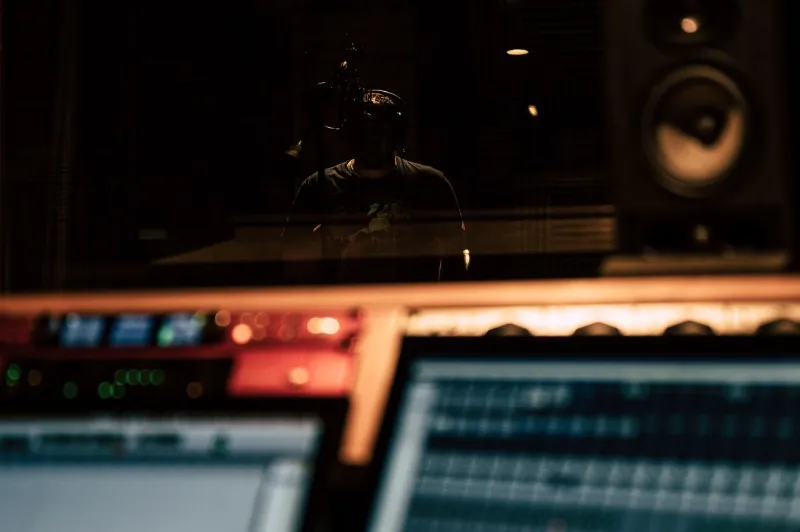
The Songs You Never Finish Might Be the Ones That Matter Most
Somewhere on your hard drive — or buried in a stack of notebooks, or living in a folder you haven't opened in two years — there's work you abandoned. A song that stalled out after the second verse. An album concept you got halfway through before you convinced yourself it wasn't good enough. A demo that felt too raw, too weird, too something to ever see the light of day.
Most artists treat that stuff like evidence of failure. I want to argue the opposite.
The Myth of the Finished Product
We've built an entire cultural apparatus around the release. The drop. The rollout. The moment something becomes official and public and reviewable. And that framework does something quietly damaging — it trains us to measure the value of creative work by whether it crossed the finish line.
But here's the thing about finish lines: they're kind of arbitrary. The decision to call something "done" is just that — a decision. Sometimes it's an artistic one. A lot of the time, it's a practical one. Deadlines, budgets, label pressure, the exhaustion of living inside a project for too long. The finished version of a song isn't always the truest version. It's just the version that made it out.
Some of the most fascinating creative documents in music history are the ones that didn't make it out. The Beach Boys' SMiLE sat unfinished for nearly four decades before Brian Wilson finally completed it in 2004. In the meantime, the bootlegs and fragments that circulated became almost mythological — evidence of a creative mind working at a frequency that resisted completion. D'Angelo's gap between Voodoo and Black Messiah wasn't empty. It was full of abandoned material, false starts, and experiments that reportedly never resolved into anything releasable. And yet that period of invisible work shaped everything that eventually came.
Perfectionism Is a Creativity Tax
There's a version of perfectionism that looks like high standards. And then there's the version that's actually just fear wearing a very convincing disguise.
When you abandon a project because it "isn't ready," it's worth asking: ready for what, exactly? Ready for judgment? Ready to be compared to the last thing you put out? Ready to justify the time you spent on it? Because those aren't really artistic criteria. Those are social ones.
The demand for constant polished output — especially in the current content cycle where artists are expected to be perpetually releasing, posting, and engaging — creates a kind of creative pressure that's not actually compatible with how good work gets made. Good work usually requires a lot of bad work first. It requires false starts and half-baked ideas and songs that go nowhere. If you're only counting the stuff that ships, you're not counting most of the actual creative labor.
And when perfectionism makes you terrified to produce anything that isn't immediately presentable, the unfinished pile grows. Not because you're failing — but because the bar for "done" has become so impossibly high that almost nothing clears it.
The Creative Value of the Vault
Taylor Swift has made the concept of the vault genuinely interesting from a fan engagement standpoint — those unreleased tracks that surface years later, carrying a different kind of emotional weight precisely because they were held back. But the vault isn't just a marketing tool. For artists, it's a record of who you were at a specific moment in your creative development.
That unfinished album from three years ago? It captured something real about where you were emotionally, sonically, artistically. The fact that it didn't resolve into a neat twelve-track release doesn't erase what it was. It's a document. And documents have value even when — maybe especially when — they're incomplete.
A lot of artists who go back and revisit old abandoned material report the same experience: surprise. They find ideas in that old work that they'd forgotten they were capable of. Approaches they'd moved away from that suddenly feel relevant again. Sometimes an unfinished song from five years ago becomes the seed of something new. The vault isn't a graveyard. It's more like a root system.
Embracing the Mess as Part of the Practice
This is ultimately a case for reframing what creative success looks like on a daily level. If the only things that "count" are the finished, released, publicly visible outputs, then you're discounting enormous amounts of legitimate creative work. The experiments that taught you something. The songs that helped you process something difficult even if they never found a home on a record. The weird genre-crossing attempts that didn't land but pushed your ear somewhere new.
All of that is the work. The stuff that ships is just the visible portion of it.
Some practical ways to shift this relationship:
Keep a creative archive, not just a release catalog. Document the abandoned stuff. Date it. Give it a title even if it's just a working one. Treat it like it matters, because it does.
Set aside projects without closing them. Instead of deciding something is "dead," put it in a folder labeled something like "later" or "maybe." Give yourself permission to return without the pressure of ever having to.
Let unfinished work be a sandbox. Use those abandoned projects to experiment with techniques, production choices, or lyrical approaches you're too nervous to try on something you're planning to release. The stakes are lower. That's a feature, not a bug.
Separate creation from curation. You are both the artist making the work and the editor deciding what goes out. Those are different jobs. The maker shouldn't be silenced by the curator's judgment before the thing even exists.
The Work That Lives in the Dark
There's something almost sacred about the work that never gets released. It exists outside the cycle of promotion and reception and algorithmic performance. Nobody's rated it. Nobody's compared it to your last thing. It's just the thing itself, in whatever unresolved state it's in.
For a lot of artists, that's actually the freest space in their entire creative life.
Your unfinished album isn't proof that you didn't follow through. It might be proof that you were reaching for something complicated enough to resist easy completion. That's not a flaw in your process. That might be the most interesting part of it.